Research in Structural Dynamics
Discovering Hidden Dynamic Couplings in Aero-Engines
My PhD at Imperial College London (Rolls-Royce UTC) expanded the current knowledge on hidden vibration interactions in aero-engine rotors, which are likely to affect newer generation designs.
By combining advanced modelling with a custom-built test rig, I demonstrated that the long-standing assumption of independent shaft, disc, and blade dynamics breaks down under modern architectures.
These findings imply that new design requirements are needed to safeguard the structural integrity and reliability of future ultra-efficient engines.
Research Summary
Next-generation aero-engines rely on shorter, stiffer shafts carrying longer, more flexible blades. These designs improve aerodynamic efficiency and reduce noise, but they also create hidden vibration risks.
This raised a key question: could vibrations in different parts of the rotor, once thought independent, actually interact in unexpected ways?
In my research I uncovered and validated entirely new families of coupled shaft-disc-blades modes. Using advanced finite element models, I showed that asymmetric bearing supports can cause shaft bending and axial motions to merge into new “hybrid” modes. Extending the analysis to bladed discs showed that torsional, lateral, and axial vibrations can also combine into unique, fully coupled behaviours.
Figure 1. Shaft Bending to Disc 0ND Coupled Mode.
Figure 2. Blade 0ND Bending to Shaft Torsional-Axial-Bending fully Coupled Mode.
To validate the predictions, I adapted the existing ARES rig facility by designing, commissioning, and installing a new asymmetric support structure. This bespoke setup allowed us to deliberately trigger the predicted couplings on a real rotating system. Experiments confirmed the predictions and even revealed additional vibrational couplings when a disc is mistuned.
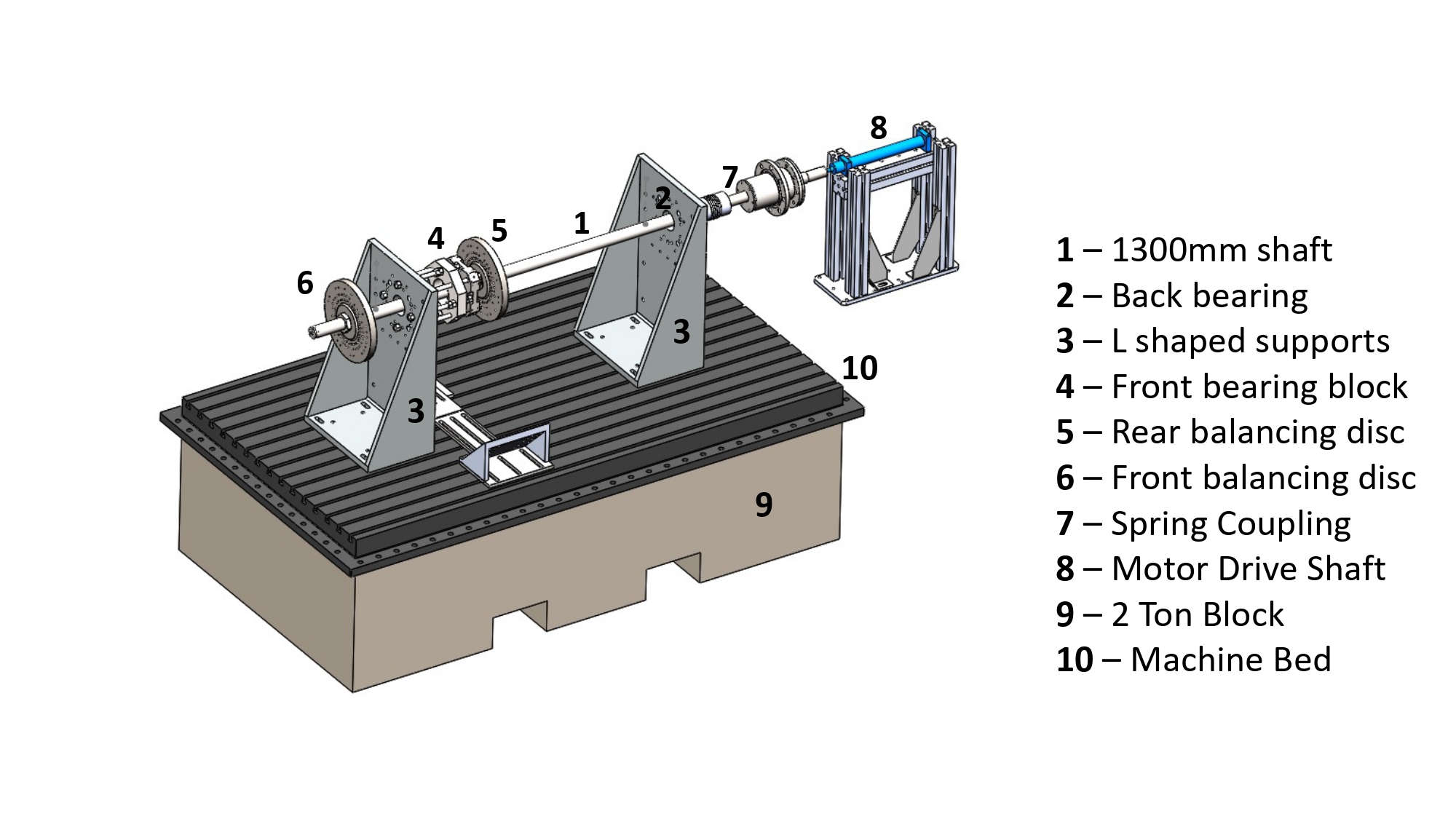
Figure 3. Pre-existing ARES rig
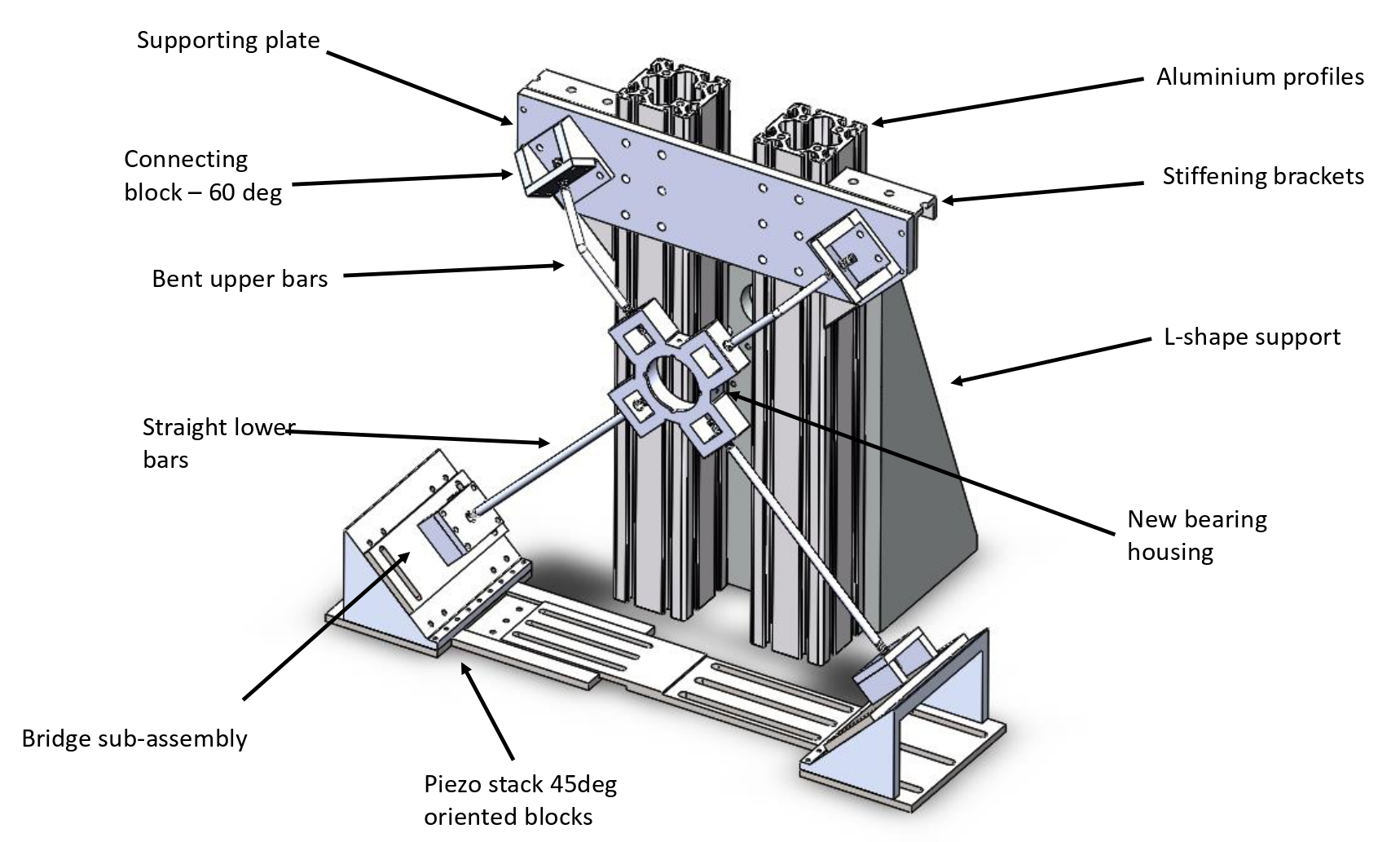
Figure 4. Asymmetric bearing support assembly added for experimental validation
My Approach to Research
At the core of my approach to research is a drive to understand the underlying physics of complex systems and to translate that understanding into reliable numerical models. I approach each problem by digging into the fundamentals first, ensuring that every assumption is physically sound and every result traceable to the mechanisms at play.
I have a proven ability to step into new topics with limited prior exposure, quickly surveying the literature, identifying what is known and, more importantly, what is missing. This allows me to define clear, focused research plans that address real gaps.
My work combines a deep knowledge of computational mechanics and structural dynamics with hands-on experimental practice. I used and developed numerical tools (FEM, signal processing, bespoke Matlab/Python routines) alongside laboratory procedures (shaker tests, rig commissioning, vibration measurements) to validate and refine models. This dual focus ensures that my research is both rigorous in theory and grounded in physical reality.
Methods & Tools:
- FEM: Abaqus (with Python scripting), fully self-developed models in Matlab
- CAD: Solid Works
- Data Acquisition: SignalCalc, LabView
- Experimental Techniques: Hammer tests, Shaker tests, Unbalance tests
- Programming Languages for pre and post-processing: Matlab, Python
Publications
-
Study of coupling between shaft bending and disc zero nodal diameter modes in a flexible shaft-disc assembly
Journal of Sound and Vibration, 2020
DOI -
Cross-disc coupling in a flexible shaft–disc assembly in presence of asymmetric axial–radial bearing supports
Journal of Sound and Vibration, 2022
DOI -
Shaft Bending to Zero Nodal Diameter Disc Coupling Effects in Rotating Structures Due to Asymmetric Bearing Supports
Conference Proceedings of the Society for Experimental Mechanics Series (IMAC), 2020
Springer Link -
Coupling between axial, lateral and torsional vibration modes of a flexible shaft with flexible staggered blades
Proceedings of the International Conference on Vibrations in Rotating Machinery (VIRM), 2020
Taylor & Francis Link -
Investigation on coupling between disc umbrella mode and shaft bending modes in a rotating shaft-disc assembly
Journal of Physics: Conference Series, 2019
IOP Link